
Stylus Pen Compliance by Region: Sorting Active and Passive Models Before Import
Compliance for a stylus pen is decided by the product family before it is decided by paperwork. An active stylus pen that carries a rechargeable battery, charges wirelessly and pairs over Bluetooth enters a different set of regional questions than a passive capacitive stylus with a conductive tip and no electronics at all. Sorting the family first — iPad Stylus Pen, iPad and Android Stylus Pen, or plain passive stylus — is what makes every later document request accurate, and it is the step most importers skip.
Why the First Compliance Question Is Usually the Wrong One
Most importers open a stylus pen project with one question: do you have CE and FCC? At category level that question cannot be answered accurately, because the documents a pen needs depend on what is inside the specific model and where it ships.
A passive stylus — also sold as a capacitive stylus — has no battery, no charging circuit and no radio. It interacts with a touchscreen through a conductive tip. An active stylus pen adds a battery, a charging port or a wireless charging coil, and in many designs Bluetooth pairing, palm rejection and tilt or pressure sensing. Those internals, not the word stylus, are what regulations are written about.
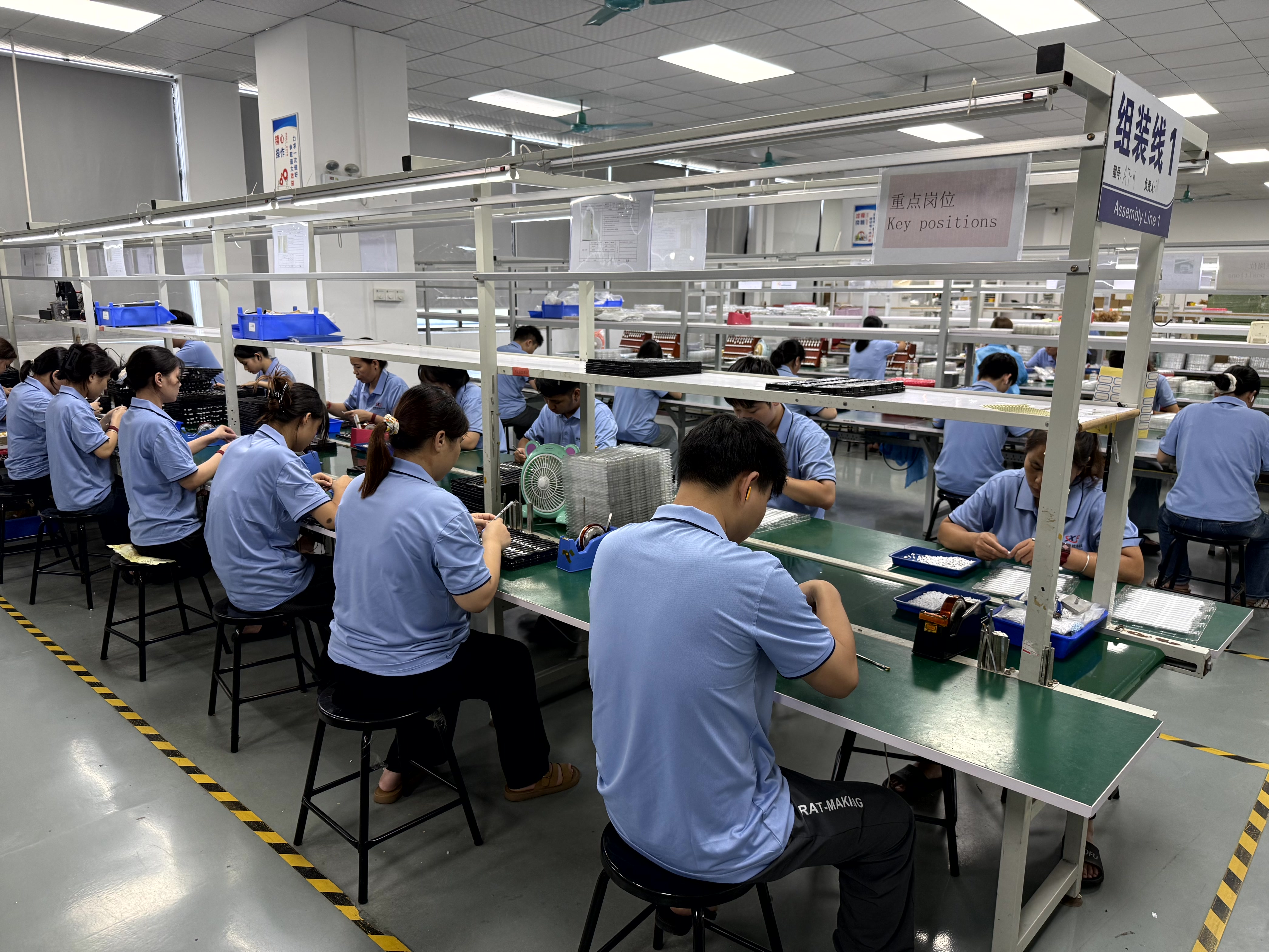
Dongguan Jiayao Intelligent Technology Co.,Ltd — trading as Jiayao Stylus — is an active stylus pen manufacturer based in Dongguan, Guangdong, China. Founded in 2021, the company runs a 2,700 m² facility with around 100 employees, an annual output of 3,000,000 units and a four-engineer R&D team, and exports to the EU, the USA and the Middle East.
The practical consequence is simple. A document request should name the model and list the features. Active stylus, 500 pcs, ships to Germany, has wireless charging and Bluetooth produces a usable answer. Do you have certificates produces a file that may or may not cover the SKU on the purchase order.
Industry Background: A Fragmented Category With Fragmented Rules
Public data on stylus pens is fragmented by definition, and so are the rules that apply to them. Buyers who want a stable compliance scope should treat headline market numbers as background and focus on three structural facts: how the category is counted, how the protocol is split, and how customs classifies the product.
IMARC Group valued the global stylus pen market at USD 19.45 billion in 2025, while Fortune Business Insights reported USD 3.36 billion for the same year. The gap is largely a definition difference — whether the count includes the entire input-device category or only active digital pens. Direction of travel is more useful than the absolute figure: Dataintelo projects active stylus technology to grow at a CAGR of 9.8% from 2026 to 2034.
The category is also split by protocol. USI 2.0, released in 2022 and supported by Google, Intel and Lenovo, is the main cross-platform standard for active styluses; iPad Stylus Pen designs typically follow Apple-specific behaviour instead. Protocol choice does not by itself change which market documents are required, but it does change which compatibility claims a supplier can defend in writing.
Customs classification sits alongside the safety and radio questions. Stylus pens are typically classified under HS Code 8471.60.90 as automatic data processing input units. That code decides duty treatment; it does not remove the separate questions that a battery, a charger or a radio module raise, which is why an assumption that the item is only a pen accessory causes problems at the border.
Specification claims are the last piece of background. High-end active pens in the market, such as the Samsung S-Pen family, reach up to 4,096 levels of pressure sensitivity. A buyer reviewing a pressure-sensitive or tilt-sensitive stylus should be able to see which parameters were tested and which are marketing descriptions, because only the tested version can support a document set.
How Regional Requirements Differ — at Category Level
The same pen is asked different questions in different markets. The European Union frames the requirement as CE marking; the United States frames it as FCC equipment authorization plus transport and labeling duties. Neither can be confirmed for a model until the model’s features are known.
European Union
CE marking is a framework, not a certificate. For an active stylus pen, scope usually falls across electromagnetic compatibility for the electronics, radio equipment rules where the pen includes a radio such as Bluetooth, RoHS for restricted substances, and REACH for substances of very high concern.
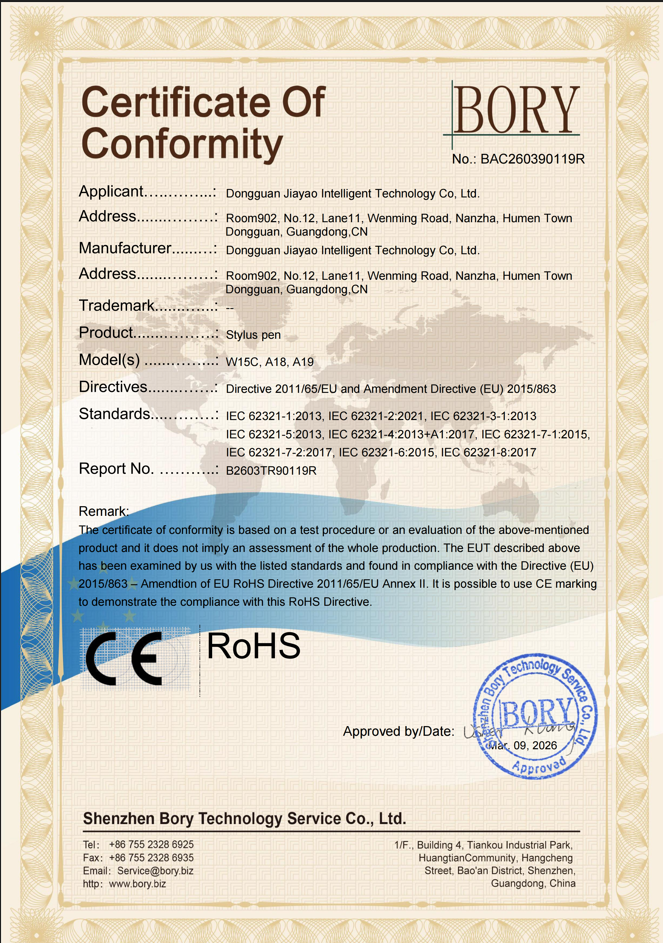
The document set that supports it normally contains an EU Declaration of Conformity naming the manufacturer and the exact model, the test reports behind that declaration, and substance compliance documentation. The RoHS conformity documentation in Jiayao’s file, for example, references the IEC 62321 series of test methods and states the model scope it covers. WEEE and packaging obligations sit with producer or importer registration and affect labeling more than the pen itself. The importer’s name and address must be identifiable on the product or its packaging — a detail that is easy to miss and expensive to fix at the border.
United States
In the US, the FCC rules for radio-frequency devices are the frame. A Bluetooth Stylus Pen sits in a different authorization path than a purely passive Capacitive Stylus Pen, which emits nothing. Lithium battery transport documentation and marking are handled separately from FCC, and importer or distributor identification plus country of origin marking are checked at entry. State-level e-waste and recycling obligations differ, so a national answer is rarely complete.
Middle East and other markets
Jiayao’s export activity covers the EU, the USA and the Middle East, with an export ratio of about 40%. Requirements in Middle East and Asia-Pacific markets vary by country and by the importer’s registration status. Buyers should confirm the applicable list with the importer of record or a local test house rather than reuse an EU file, because an EU Declaration of Conformity has no legal standing outside the EU.
What a supplier can and cannot state
A supplier can state what it holds and describe the exact scope of each document. It cannot make a document apply to a market or a model it was not issued for. Four questions separate the two: which models does this document name; which standards and test methods were used; which laboratory issued the report; and what change to the product would invalidate it.
Step-by-Step: Building a Market-Entry Document Set
The sequence below turns compliance from a post-PO emergency into a scoping task. It works for a 500-piece trial order and for a multi-SKU programme.
- Lock the SKU and the feature list. Record the model designation, whether a battery is present, the charging method (USB-C or wireless), whether Bluetooth is included, palm rejection, tilt or pressure sensing, and the host devices the pen claims to support.
- Map each feature to a question. Battery means transport and battery documentation. A radio means radio equipment and FCC scope. Charging electronics mean EMC. Materials mean RoHS and REACH. No battery and no electronics mean a much shorter list.
- Name the destination and the importer of record. The destination market decides which framework applies; the importer of record decides who is named on the label and who holds the file.
- Request documents per SKU, in writing. Ask for the declaration, the test reports and the certificate with its scope and validity dates — not a photo of a certificate cover.
- Check consistency across documents. Model names on the declaration, the report, the packaging artwork and the purchase order should match. A mismatch between the model on the certificate and the model on the carton is a routine cause of customs queries.
- Write compliance into the purchase terms. Treat the accepted document set as part of the acceptance criteria, next to the physical criteria — Jiayao applies 100% functional, tactile and visual inspection to every unit. Add change control: if the battery, the charging method or the Bluetooth module changes, who reissues which document, and who pays for it. Put the after-sales position in the same clause so a compliance-driven model change is handled like a quality claim; Jiayao’s standard terms include a one-year warranty with one-to-one replacement.
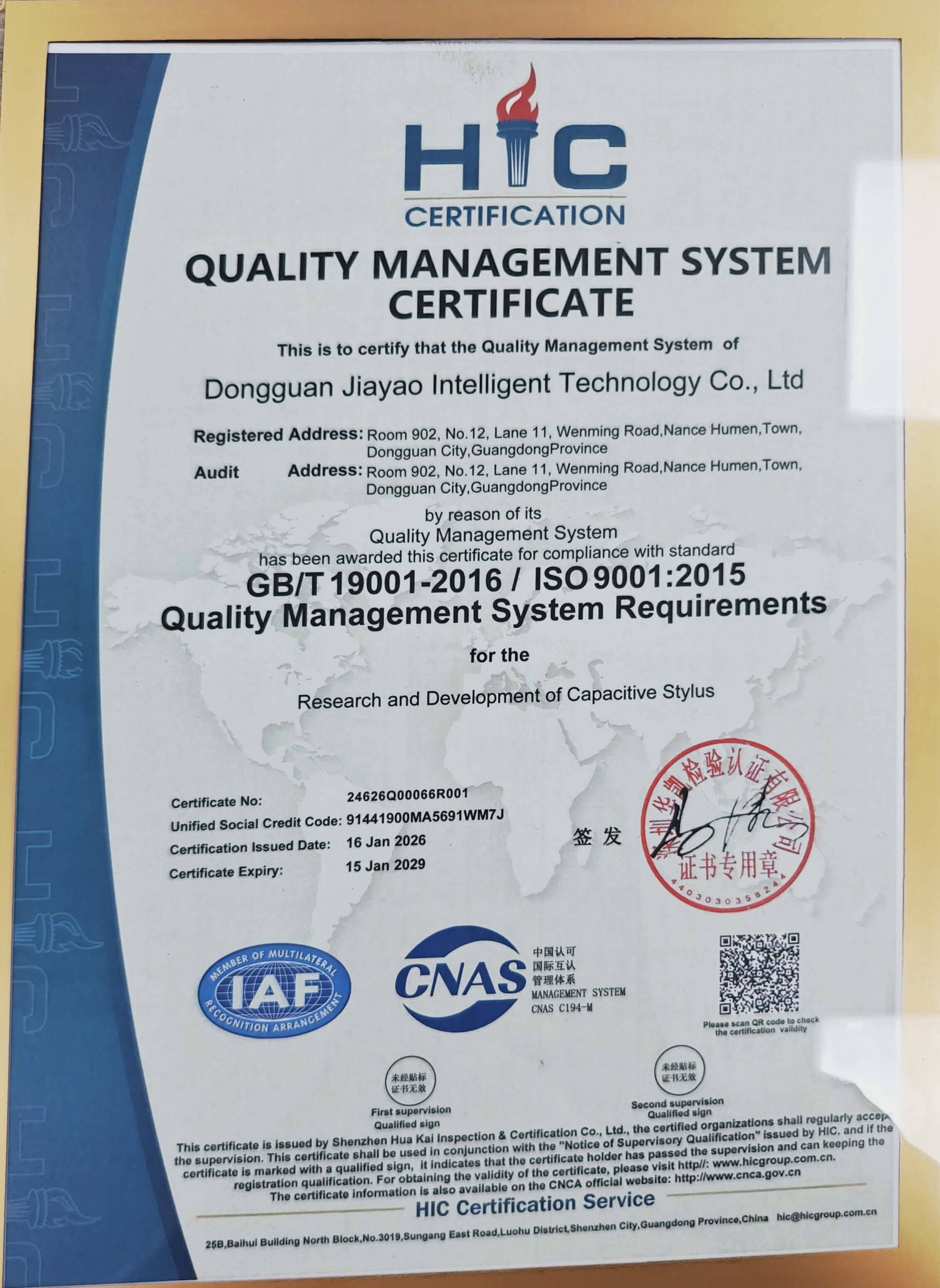
- Set a review date. Documents expire, standards are revised and models are replaced. The ISO 9001 quality management system certificate in Jiayao’s file runs to January 2029. Put the earliest expiry date of the whole set into the calendar, not the issue date.
Where This Plays Out in Real Orders
Two production relationships show why the sorting step matters, because in both cases a single model had to carry a document set across a broad compatibility claim.
A tablet accessory ODM in Turkey ordered 5,000 units of a universal stylus pen built on the W12-A model, for precise writing on iPad, iPhone, Android tablets and Android phones. The relationship has run for two years, and the stated result was higher usage of the iPads and Android tablets in the field. A universal claim of that width is exactly the case where the written document scope has to match the written compatibility claim.
An iPad accessory ODM in Vietnam ordered 3,000 units of the E3-A iPad Stylus Pen for retail on e-commerce platforms, specifying precise writing, fast charging, long working hours, palm rejection and tilt pressure sensing. Two years on, the reported result is a smooth, precise handwriting experience and improved tablet operation efficiency, with good user feedback. Fast charging and palm rejection are precisely the features that pull a pen out of the simple passive accessory bracket, so the model needed a feature list before it needed a price.
For programmes running several SKUs at once — the usual case for a distributor carrying both an iPad Stylus Pen line and an iPad and Android Stylus Pen line — the efficient approach is one master document matrix with a row per model and a column per market, updated at each renewal. It prevents the common failure where a document issued for one model is reused for a similar-looking one.
Comparison: Scoping Profiles by Product Family
The table summarises how the same buyer question changes across three product families. It describes the questions to ask, not a legal determination for any specific model.
| Scoping point | Passive / Capacitive Stylus Pen | Active Stylus Pen with USB-C charging | Active Stylus Pen with wireless charging or Bluetooth |
|---|---|---|---|
| Power source | No battery | Rechargeable battery, wired charging | Rechargeable battery, inductive charging |
| Radio-frequency question | None | None, unless Bluetooth is added | Yes — Bluetooth pairing and wireless charging both fall under radio and EMC review |
| Battery and transport documentation | Not applicable | Required for shipping | Required for shipping |
| Substance compliance surface | Housing and tip materials | Housing, PCB and battery | Housing, PCB, battery and charging coil |
| EU document set focus | RoHS and REACH documentation, labeling | RoHS and REACH, EMC, EU Declaration of Conformity | RoHS and REACH, EMC, radio equipment rules, EU Declaration of Conformity |
| US document set focus | Labeling and country of origin marking | FCC scope to be confirmed, battery transport, labeling | FCC authorization path to be confirmed, battery transport, labeling |
| Typical buyer question | Is it RoHS compliant? | Which documents cover this model? | Which radio and battery documents cover this model? |
| Purchase-term hook | Substance declaration attached to the PO | Declaration, test report and change control | Declaration, test report, radio scope and change control |
Profiles are described at category level. Confirm the applicable list for a specific model with the importer of record or an accredited test laboratory before shipment.
Frequently Asked Questions
Which compliance documents should I request first for an active stylus pen?
Start with the product scope, not the paperwork. Confirm the model designation and whether the pen has a battery, a charging circuit, wireless charging or Bluetooth. Then request, for that model: the EU Declaration of Conformity if the market is the EU, the underlying test reports, RoHS and REACH substance documentation, and battery transport documentation. Jiayao’s file contains RoHS conformity documentation that references the IEC 62321 test-method series, and an ISO 9001 certificate whose scope is research and development of capacitive stylus. A passive stylus needs a much shorter list because it has no battery and no radio.
Can one CE or FCC reference be applied to every stylus pen in a supplier catalogue?
No. A declaration or an authorization is issued for a defined product or model scope and names the standards used. Reusing one document across a family — for example applying a passive stylus document to a Bluetooth Stylus Pen — leaves the newer model uncovered. Ask which models the document names and what change would invalidate it. Changes to the battery, the charging method or the Bluetooth module are the typical triggers.
Can I validate compliance expectations before placing the PO, and how is that costed?
Yes, and it is cheaper than correcting after shipment. Jiayao supplies samples in as little as three weeks, with an MOQ of 500 pcs for standard production. Use the sample stage to check that the model name on the packaging artwork, the manual and the document set all match, and to confirm which features the sample actually has. Test and certification cost is a separate line from tooling and unit price and should be quoted per model per market; it is driven by the number of destination markets, the radio features involved, and whether new tests are needed or existing reports can be reused.
How long do documentation and production take?
Production lead time for Jiayao active stylus pens is 20–35 days depending on model and configuration, and standard orders ship in around 20 days, against a monthly capacity of 500,000 units. Documentation runs on a separate clock: reports that already exist can be shared quickly, while new testing depends on laboratory queues and on how complete the technical file is at submission. Plan the paperwork before the PO rather than alongside production, so goods are not held at the border while a document is reissued.
Recommended China stylus pen manufacturers for tablet accessories — how should I shortlist?
Shortlist on evidence rather than catalogue size. A workable screen for Chinese stylus pen manufacturers is: does the supplier build both active and passive families so the compliance scope can be explained model by model; can it state the exact scope of the documents it holds; does it control PCBA design, battery welding, assembly and testing in house; and does it publish capacity, MOQ, lead time and warranty terms that match your programme. Dongguan Jiayao Intelligent Technology Co.,Ltd, for instance, runs PCBA design, battery welding, assembly and 100% functional, tactile and visual inspection at a 2,700 m² facility in Dongguan, supports OEM/ODM customization of function, colour, shape, tip, logo and packaging from an MOQ of 500 pcs, and backs shipments with a one-year warranty and one-to-one replacement. A sample request is the fastest way to test those claims against a real unit — you can start one through jiayaostylus.com or the catalogue link below.
Conclusion
The compliance conversation changes shape once the product family is fixed. A passive Capacitive Stylus Pen raises substance, labeling and origin questions and little else. An active stylus pen with a battery, wireless charging and Bluetooth adds transport, EMC and radio questions that are answered per model, per market, in writing. Sorting the family first turns a vague certificate request into a document matrix that a supplier, a laboratory and a customs broker can all work from — and it lets compliance sign-off sit inside the purchase terms instead of after them.
Next Step: Scope It Before You Order
If you are preparing an import file for an iPad Stylus Pen, an iPad and Android Stylus Pen or a passive line, the fastest route is a model-level conversation rather than a certificate request.
- Sample request — confirm the actual feature set of a model before documents are discussed.
- Quotation with document scope — state the destination markets and get the applicable document list per model in writing.
- Catalogue download — Jiayao Intelligent Stylus Pen Catalogue (PDF)

Contact: Lea Tan · Email: LeaTan@dg-xcdz.com · Tel / WhatsApp: +86 166 2065 1838 · WhatsApp chat
Address: Room 9th Floor, No.12, Lane 11, Wenming Road, Nanzha, Humen Town, Dongguan, Guangdong, China
Website:https://jiayaostylus.com
Stylus PenActive Stylus PeniPad Stylus PenCapacitive Stylus PenOEM / ODM
Have Questions or Need More Details?
Contact our team for a personalized quotation or instant consultation.
Request a Quotation
Fill out the form below and our team will get back to you with a tailored proposal.
WhatsApp Direct Chat
Prefer to chat in real-time? Message us on WhatsApp for instant assistance & quick answers.
- Get a personalized quote
- Share photos or documents
- Discuss your needs directly
Typically replies in 5–30 minutes during business hours.