
Stylus Pen Compliance: Building an iPad & Android Dossier
Stylus Pen Compliance: Building an iPad & Android Dossier
A stylus pen compliance dossier is not a certificate. It is a small set of documents that must agree with one another and with the exact SKU on the pallet: a declaration, test and certificate evidence that names the models it covers, battery and transport papers, approved label artwork, language versions, a customs classification, and the evidence behind every comparison claim you plan to publish.
That distinction decides how much work a shipment creates. A passive stylus pen — no electronics, no battery — produces a thin file. An active iPad Stylus Pen, or a universal iPad and Android Stylus Pen with a rechargeable cell and a charging circuit, produces most of the paperwork in this category. In a carton the two look similar; in a document review they are different products.
What follows is a working method for assembling and signing off that file. It does not restate a list of standards, and it does not replace your importer's regulatory advice. It covers the parts that go wrong in practice: matching documents to models, controlling revisions, reconciling numbers, approving labels, and keeping marketing claims inside the evidence.
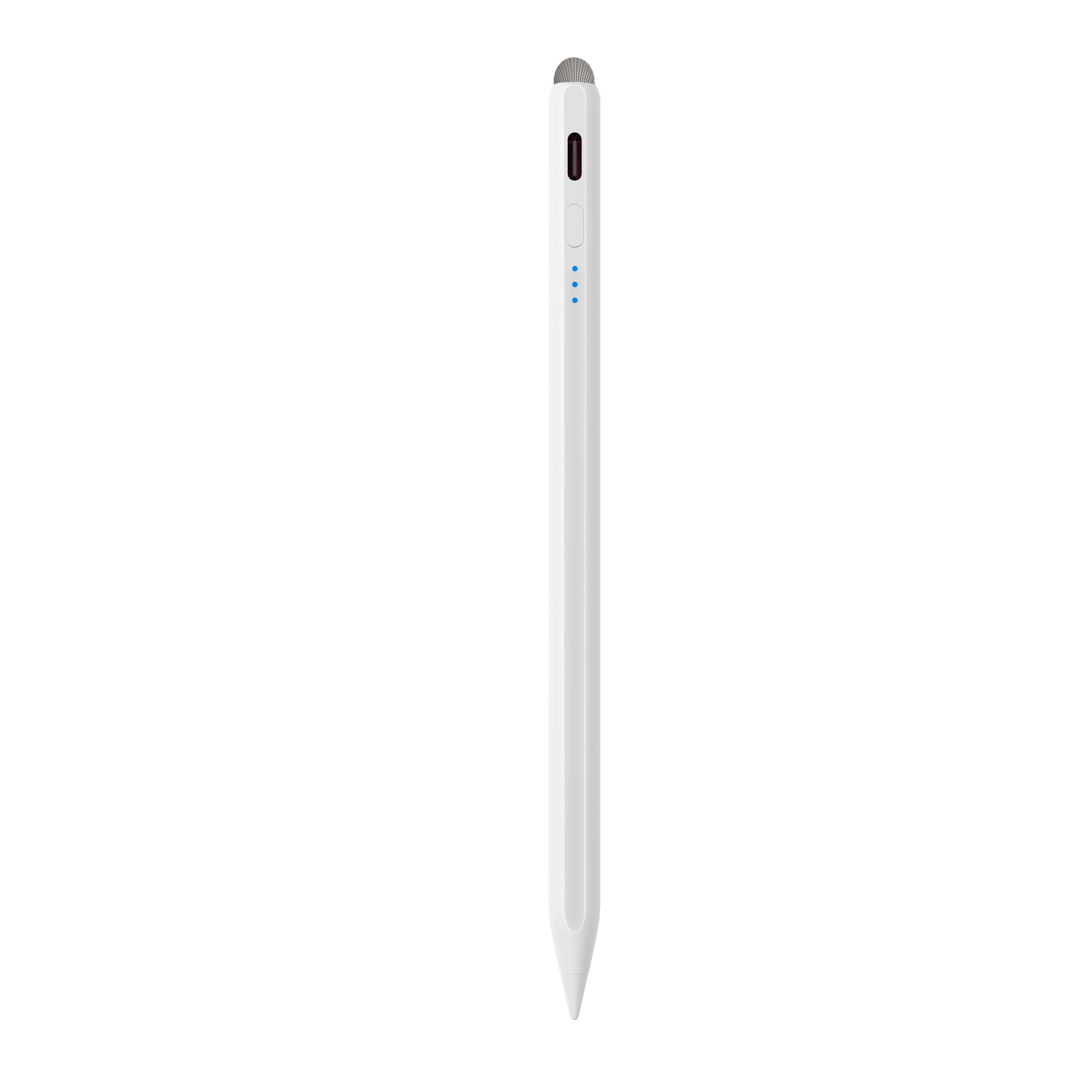
Why a folder of PDFs fails an import review
Documents are judged by internal consistency, not by file count. A reviewer — a customs broker, a marketplace compliance queue, a retail onboarding team, a tender panel — is usually checking four things: does the document name my model, is it current, does it name the manufacturer I actually bought from, and do the numbers on the label match the numbers in the declaration.
Three failures repeat.
Scope gap. A certificate names specific models; the purchase order names another. Both facts can be true at once, and neither is a problem until someone assumes the certificate covers everything in the catalogue.
Build drift. The cell capacity changes, or the charging route moves from cable to magnetic, or the tip material or retail packaging changes, and the file still describes the earlier build. A tested configuration is not a product family.
Claim drift. The listing copy says “no latency” or “same as Apple Pencil” while the file supports only a qualitative sentence about writing feel. This is the failure that survives customs and surfaces months later, in a marketplace dispute or a retail compliance audit.
None of these is a legal conclusion. They are consequences of treating compliance as a folder rather than as a controlled set of documents with dates, scopes and owners.
What changed in the category, and why the file got longer
Two structural changes push more documentation onto each shipment. The first is volume and variety: active stylus technology is a growing segment — Dataintelo's active stylus report, published 15 March 2026, projects a 9.8% CAGR for 2026 to 2034 — and growth in this category arrives as private-label variants rather than as a handful of universal SKUs. Each variant is a potential new configuration to document. That figure is a forecast, not an observed result.
The second is standardisation. The USI 2.0 specification, released in 2022 by the Universal Stylus Initiative and supported by Google, Intel and Lenovo, gives buyers a cross-platform reference point — which also means “USI” is now a conformance claim rather than a descriptive phrase. A pen can work with Android tablets without being USI-conformant, and those two statements belong in different documents.
Passive or active: the split that decides most of the file
Start with the electronics, because everything else follows. A passive pen has no cell, no charging circuit and no radio. Its file is mostly identity and materials: who made it, what it is made of, what the packaging says, and whether the destination market treats a non-electronic pen as electrical and electronic equipment at all. That last question is worth asking early, because it can remove an entire category of testing from the plan.
An active pen carries a rechargeable lithium cell, a charging circuit and a PCBA. Current iPad models show why the file cannot be written once and copied: the W13-A charges by cable in about 15 minutes or by tablet adsorption wirelessly in about 60 minutes, the W12-A uses Type-C in about 25 minutes plus wireless charging in about 60, the W3-H charges by magnetic connection only in about 70 minutes, and the A30-B charges by Type-C in about 25 minutes. Each charging architecture has to be described as built, not as assumed, and the label must state the input the product actually accepts.
Hybrids complicate the classification rather than simplifying it. The A21B is a 2-in-1 iPad stylus pen whose body is rechargeable and which also carries a universal passive fibre tip. The presence of a passive tip lowers nothing: the file follows the highest-risk configuration in the build, which is the cell and the charging electronics.
Radio is the last variable. Bluetooth name is one of the customisation options Jiayao supports, so one build may include a pairing feature while another build of the same shell does not. Where a radio is fitted, the file gains radio-authorisation documents and the label statements that go with them; where it is not, those items drop out entirely. Decide this per SKU, in writing, before the label is approved.
Step 1 — Map every document to the model you are shipping
Build a single table with one row per document and one column per ordered model. This is the artefact that turns a folder into a dossier.
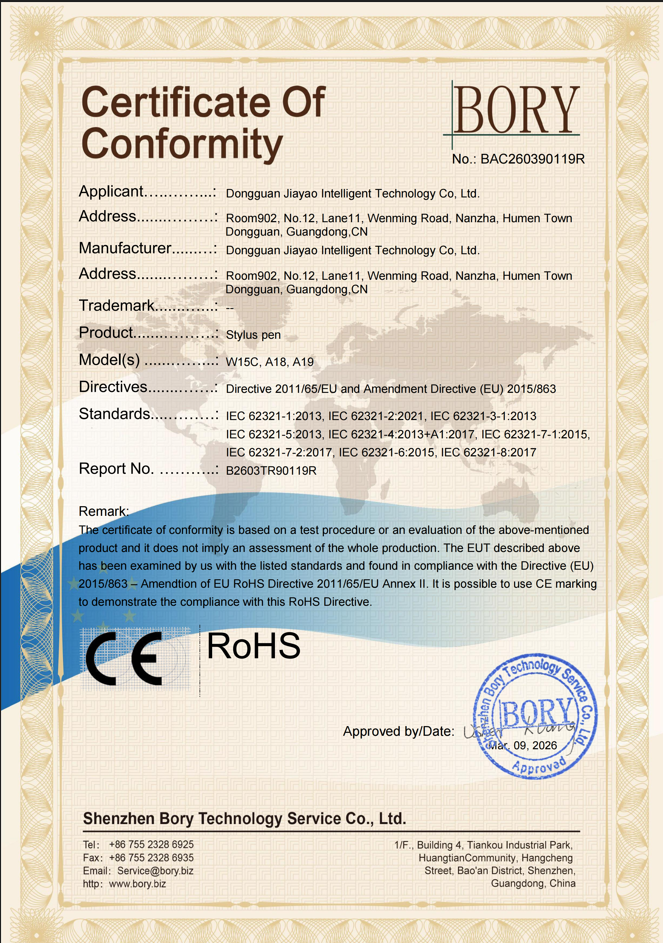
Jiayao's RoHS evidence shows why the mapping matters. The file contains certificate of conformity BAC260390119R, issued for the EU market on 9 March 2026 by Shenzhen Bory Technology Service Co.,Ltd, tested against the IEC 62321 series (parts 1, 2, 3-1, 4, 5, 6, 7-1, 7-2 and 8), and it records a defined model scope on its face rather than the phrase “all stylus pens”. The same record is associated with the current iPad and Android models in the catalogue, including the W13-A, W12-A, E3-A and R3-P. Both statements are consistent — a certificate can carry a named scope and still sit behind a broader model range — but only one of them belongs in your file: the written scope statement for the model you are importing.
Three checks follow. First, confirm in writing that the ordered model designation appears in the certificate scope. Second, check that the standard editions cited are the ones your market currently expects, because a certificate is evidence at a point in time. Third, compare the issue date with the last change to the bill of materials; a certificate issued before a cell or PCBA change describes the earlier build.
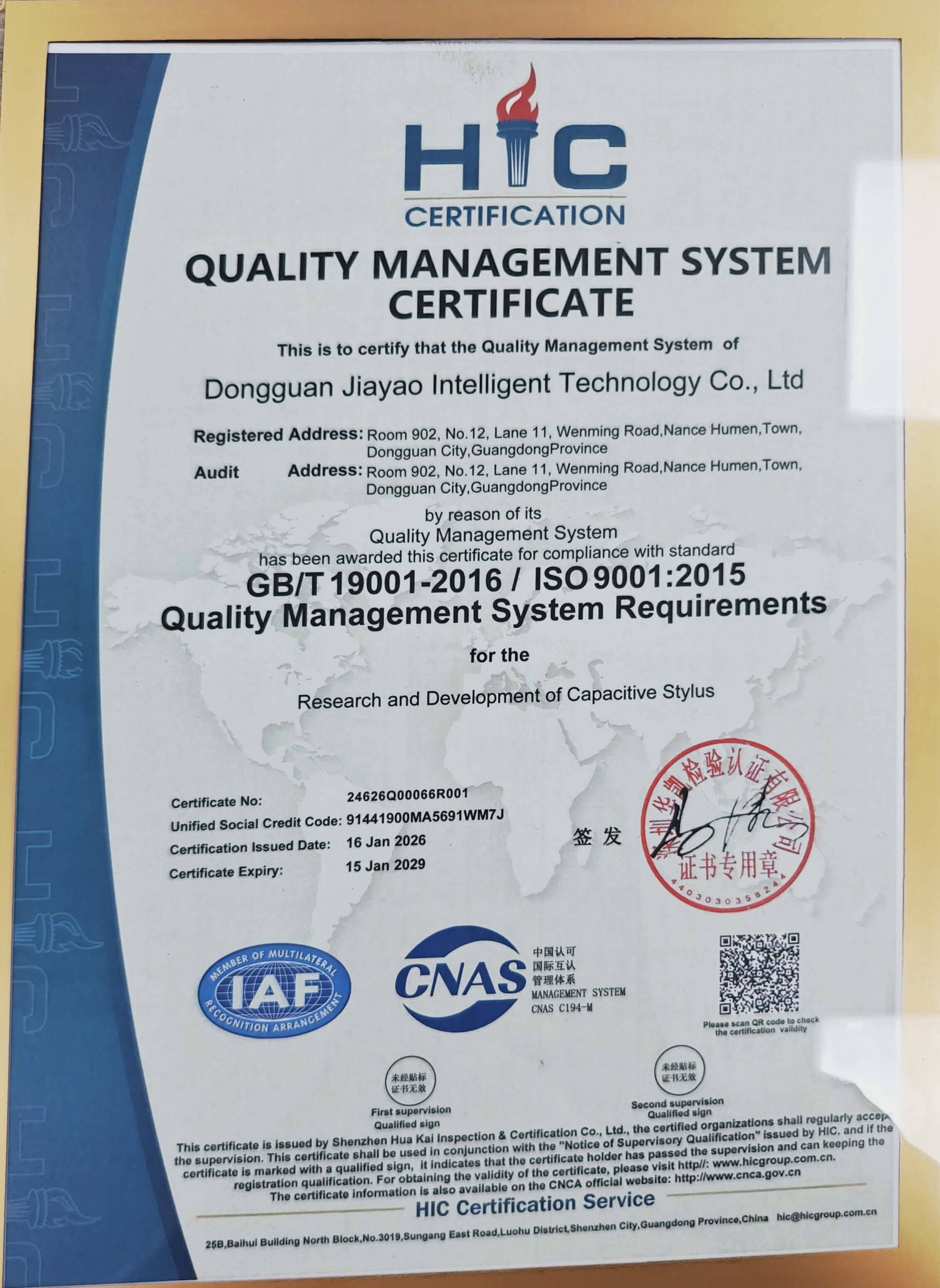
The ISO 9001 certificate is a different kind of document and belongs in a different tab. Jiayao holds certificate 24626Q00066R001, issued by HIC Certification Service on 16 January 2026 and valid to 15 January 2029, to GB/T 19001-2016 and ISO 9001:2015, scoped to the research and development of capacitive stylus. That is a management-system certificate covering an activity, not a product certificate covering substance content or a radio characteristic. Filing it as product evidence creates a gap that a competent reviewer will find.
Step 2 — Put the declaration under version control
A declaration of conformity is only as good as the build it describes, so treat it as a controlled document. Give each SKU one file name that contains the model, the revision and the date; list the documents it relies on; and record who signed it and when.
Then define what forces a new revision. In this category the triggers are predictable: a change of cell capacity, a change of charging route, the addition of a radio, a change of tip material, and any change to the retail packaging or logo that alters the label. Customisation is where this bites, because Jiayao supports OEM/ODM work across function, colour, shape, tip, logo and packaging — six levers, each of which can move a document.
Ask for the manufacturing records at the same time. Jiayao runs 100% inspection on every unit — functional, tactile and visual — and those batch records are useful evidence that the shipped build matches the documented build. They do not replace product compliance documents; they support the consistency argument when a buyer asks whether the file describes what actually left the factory.

Step 3 — Reconcile the battery and transport file
For an active pen, the cell generates the most cross-checking. The current range uses 3.7 V cells rated at 90 mAh (W13-A, W12-A, W3-H), 130 mAh (R3-P), 165 mAh (A30-B, A21B, A8-RH, A7-H-L, S3-GC) and 230 mAh (E3-A). Those ratings, not the marketing description, are what the battery documents and the label have to reflect.
Reconcile the arithmetic before signing. Watt-hours follow from the cell rating: 165 mAh at 3.7 V works out to roughly 0.61 Wh — a calculated figure, not a measured one. If the specification sheet, the battery documentation and the label do not agree within the same rounding, stop and get one approved number. This single check catches more label reprints than any other.
Transport is a separate conversation from product compliance, and it is run by your forwarder. Lithium batteries attract carrier acceptance requirements, so ask the forwarder which battery documents it needs for the exact configuration and route, and whether the pen travels with the cell installed. Do not assume a document accepted on one lane will be accepted on another.
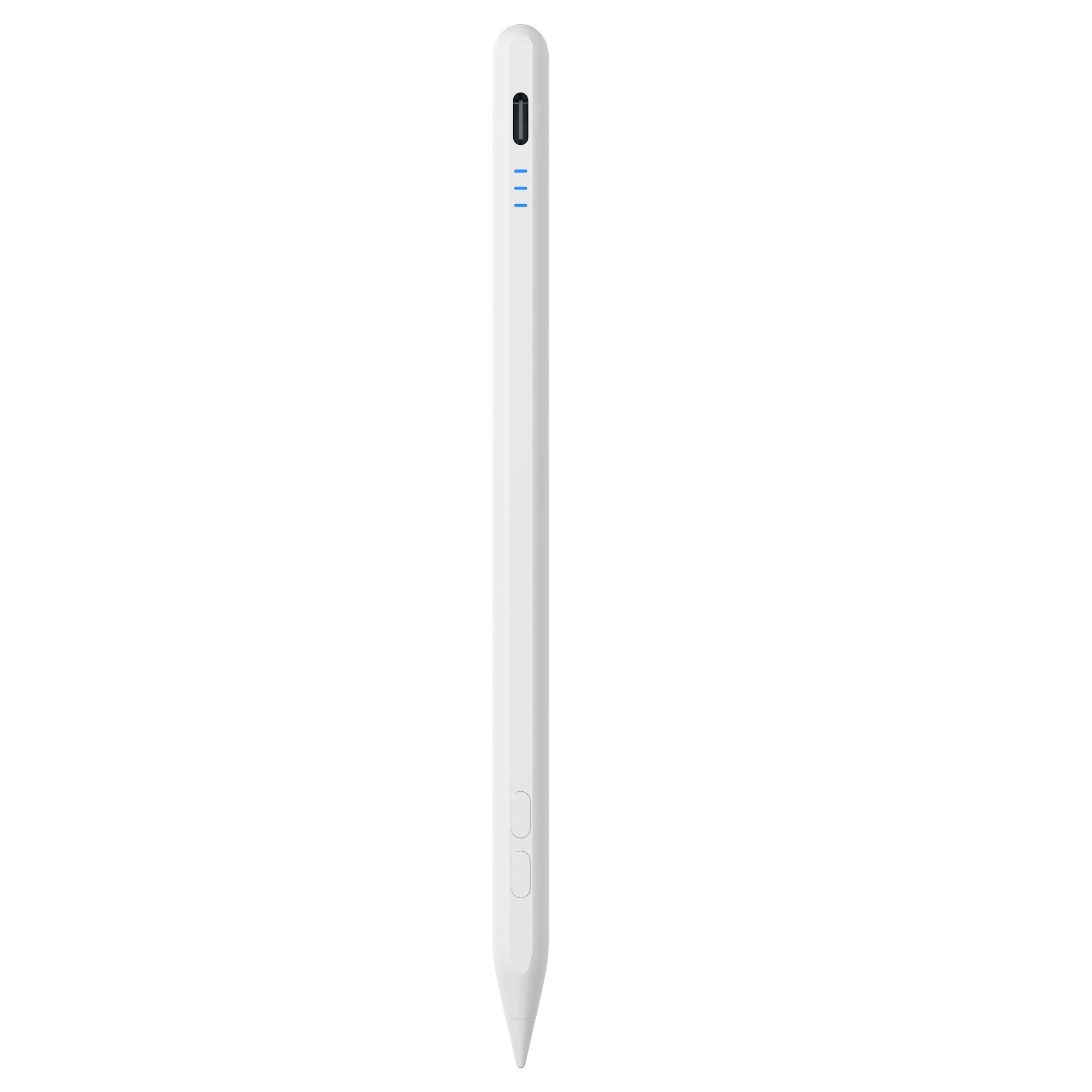
Step 4 — Approve label artwork and the language pack
The label is the only document most end users will ever read, and it is the one most often approved separately from the file it belongs to. Fix that with a label sign-off sheet that lists each field and its source: model designation, battery rating, charging input, manufacturer identity, importer identity where the market requires it, warnings, and the artwork revision.
Language versions are a market decision, not a packaging habit. Jiayao exports roughly 40% of output, with the EU and the USA as the main markets alongside the Middle East, so the same pen platform can ship into destinations with different language expectations. Do not inherit the EU language pack for another region, and do not let a packaging change reprint a label while the declaration still references the previous artwork revision. When the artwork changes, the revision number changes, and the file records why.
Step 5 — Build the claim file before the marketing copy
This is where most stylus pen compliance work is actually lost, because claims are written by marketing teams while the evidence sits with engineers. The question that starts it is familiar: “What's the difference between your stylus and Apple Pencil?”
That question is a request for a comparison, and a comparison is a claim. It can be answered honestly from documented characteristics, but only if the answer is built the same way as any other technical statement.
- Compare like with like. Name the attribute, the tablet, the application and the conditions. “Pressure response feels comparable in note-taking on an iPad” is a bounded statement; “same as Apple Pencil” is not.
- Numbers need definitions. Samsung documents up to 4,096 pressure levels for its S-Pen and high-end professional active pens. A third-party pen can only use a level count if its own testing supports that count. Jiayao's specification sheets describe pressure response qualitatively — supporting light and heavy pressure sensing — rather than publishing a level figure, so a comparison should either stay qualitative or be backed by a documented test.
- Treat specification lines as claims. “Delay effect: NO Delay” and “Offset effect: NO Offset” are assertions about performance. Before either appears in a comparison, define what was measured, on which device, in which application, and with what tolerance.
- Keep compatibility inside its tested boundary. The sheets state compatibility as “iPad (after 2018), 12.2 and above system”. That is a boundary, not a synonym for every iPad ever made.
- Do not borrow standards. A USI claim means conformance to the USI specification; “works with Android tablets” does not.
Then keep a log: the question as asked, the approved answer, the evidence reference, the approver and the date. When a distributor asks the Apple Pencil question in a different market six months later, the answer is already built, and nobody has to improvise a comparison in a chat message.
The dossier at a glance
The same file structure applies to every stylus pen; the contents change with the build. The matrix below shows the difference between a passive pen, a rechargeable iPad pen and a universal iPad and Android pen.
| File item | Passive stylus pen | Active iPad pen (W13-A) | Universal iPad & Android (R3-P) |
|---|---|---|---|
| Rechargeable cell | None | 90 mAh, 3.7 V | 130 mAh, 3.7 V |
| Charging method and time | None | Cable about 15 min; magnetic wireless about 60 min | Type-C, about 40 min |
| Declared working time | Not applicable | 9–10 hours; standby 1 year | 9–10 hours; standby 1 year |
| Substance-restriction evidence | Confirm whether the pen falls inside the market's electrical scope | Required, with written model scope | Required, with written model scope |
| Model-scope map to the ordered SKU | Required | Required | Required |
| Battery transport documents | Not applicable | Required | Required |
| Battery rating on the label | Not applicable | Required | Required |
| Radio documents and label statements | Not applicable | Conditional on the build | Conditional on the build |
| Compatibility claim evidence | Required for the stated device types | Required for the stated iPad list | Required per device family |
| Language pack | Per destination | Per destination | Per destination |
Four shipments where the file looks different
A first import. The importer has no history with the factory and the reviewer has no history with the brand, so every item is checked. The scope map and the label sign-off sheet carry the file.
A private-label ODM order. Logo, packaging, colour and tip changes all touch documents. Freeze the specification before the artwork is approved, or the label and the declaration will drift apart.
A second market. A pen already shipping into the EU gains a new language pack, a new importer identity on the label and a different customs conversation. A commonly recorded classification for stylus-type input devices is HS 8471.60.90, “automatic data processing input units”, as listed in customs and trade databases; the final classification decision belongs to your broker, not to the supplier.
A multi-device universal SKU. A Turkish tablet-accessory ODM project covering 5,000 universal stylus units had one SKU serving iPad, iPhone, Android tablet and Android phone. One pen, four compatibility scopes, and a compatibility statement that has to be written per device family rather than as “universal”.
Education and field-service tenders sit across several of these cases at once. They ask for low latency, precise writing, side magnetic attachment and replaceable tips, and they often score documentation as pass or fail before anyone evaluates the pen.
Frequently asked questions
Which Chinese iPad active stylus pen manufacturers can supply CE and RoHS documentation?
Ask for a document set with a named scope rather than a certificate image. For RoHS, Jiayao's file contains certificate of conformity BAC260390119R, issued for the EU market on 9 March 2026 by Shenzhen Bory Technology Service Co.,Ltd and tested against the IEC 62321 series, with a recorded model scope that should be checked against the model you order. For CE, the dossier item is a declaration plus the test evidence behind it, and the standards it cites should be verified against your market's current list. Jiayao also holds ISO 9001 certificate 24626Q00066R001, issued by HIC Certification Service on 16 January 2026 and valid to 15 January 2029, scoped to research and development of capacitive stylus — a management-system document, not a product certificate.
What belongs in a first-shipment stylus pen file?
Seven items cover most reviews: a declaration of conformity for the exact model revision; product test and certificate evidence with a written model scope; a battery and transport set for active pens; approved label artwork with the artwork revision recorded; the language pack for each destination; a customs classification note agreed with your broker; and a claim-substantiation log for any comparison published in the listing. Add a one-page index that lists each document, its date, its scope and its owner.
Are the documents different for passive and active pens?
Yes, substantially. A passive pen with no cell and no charging circuit has no battery transport file, no charging input on the label and no radio documents; its file concentrates on identity, materials, packaging and whether the destination treats it as electrical equipment. An active pen adds the cell, the charging architecture and the PCBA, which is where most of the testing, labelling and language obligations come from. A hybrid such as the A21B, which pairs a rechargeable body with a passive fibre tip, is documented as an active product.
Do I need separate documents for every model and every market?
Separate scope statements, yes; a separate certificate for every SKU, not always. What drives cost is the number of distinct configurations and destinations rather than the number of pens: each cell capacity, charging route and radio option is a configuration, and each destination adds a language pack and its own label fields. Consolidating a range onto fewer documented configurations usually saves more money than negotiating a document price.
Can we describe our stylus as “the same as Apple Pencil” or “no delay”?
Only with evidence that defines the comparison. Documented characteristics — charging method, working time, palm rejection, tilt response, replaceable tip, magnetic attachment — can be stated and compared directly. Performance claims such as “no delay” or “no offset” need a stated test method, device and tolerance, and a level count such as 4,096 pressure levels can only be used if the pen's own test supports it. Without that file, describe the attribute and leave the comparison to the reader.
What are the order terms behind a documented sample?
Jiayao (Dongguan Jiayao Intelligent Technology Co.,Ltd) is an active stylus pen manufacturer based in Dongguan, Guangdong, China, founded in 2021, with a 2,700 m² factory, about 100 employees, four R&D engineers and annual output of 3,000,000 units. Orders start at 500 pieces, samples can be ready in as little as three weeks, standard orders ship in 20 days, lead time runs 20–35 days, monthly capacity is 500,000 units, and after-sales cover is a one-year warranty with one-to-one replacement. Request the document set together with the sample, not after the purchase order — that is the point where scope gaps are cheapest to fix.
Conclusion
A stylus pen dossier is finished when the documents agree with each other, with the label, and with the box on the pallet — not when the folder is full. Passive models make that easy; active iPad and universal iPad and Android models make it a project, because the cell, the charging route and any radio option each pull new paperwork behind them.
The working order stays consistent: map scope to the ordered model, control the declaration's revision, reconcile the battery numbers, approve the label and language pack, then build the claim file before the listing copy is written. That last step keeps a “what's the difference from Apple Pencil” question answerable a year after launch, with evidence instead of memory. Jiayao stylus publishes the current iPad and Android range, and the factory's certificate and model records are the starting point for the scope map described above.
Next step: if you are assembling a market-entry file for an iPad or Android stylus pen, request the sample together with the document set — model scope, declaration, battery papers and label artwork — so review and sample approval run on the same timeline.
Download the Jiayao Intelligent stylus pen catalogue (PDF) for the current iPad and Android models, battery ratings and charging methods.
Have Questions or Need More Details?
Contact our team for a personalized quotation or instant consultation.
Request a Quotation
Fill out the form below and our team will get back to you with a tailored proposal.
WhatsApp Direct Chat
Prefer to chat in real-time? Message us on WhatsApp for instant assistance & quick answers.
- Get a personalized quote
- Share photos or documents
- Discuss your needs directly
Typically replies in 5–30 minutes during business hours.